Search This Blog

Monday, July 4, 2011

Top 5 Waterfalls of the World

Iguazu Falls
Its brink spans a distance of an incredible 2km in its average flow of 1.3 million liters per second. The falls actually consists of some 275 individual waterfalls and cascades. Catwalks make it easy to get closeup and intimate views and the rainforest surroundings make the scenery feel right for a natural attraction.


Victoria Falls
Victoria Falls is the largest singular waterfall in the world spanning a width of 1.7km, a height of 108m, and an average flow of 1 million liters per second! It's no wonder this 'smoke that thunders' is considered one of the seven natural wonders of the world and is a UNESCO World Heritage site.


Niagara Falls
Easily the most famous waterfall in North America, this powerful waterfall also ranks as the biggest one by volume with a whopping average of about 750,000 gallons per second (2.8 million Liters per second)! In addition to its raw power, the falls is easily one of the easiest to access and view from all sorts of angles.


Plitvice Falls
When it comes to the overall waterfalling experience, it's hard to beat this world famous attraction. This one is really a network of countless waterfalls (some of which are impressive enough to stand out on their own). The waterfalls themselves segregate the many clear and colorful lakes that bring life to this lush and protected ecosystem.


Angel Falls
Plunging uninterrupted for 807m (with total drop of 979m) from a mystical tabletop mountain (tepuy) deep in a Venezuelan equatorial rainforest, it is widely acknowledged as the tallest permanent waterfall in the world. Its existence defies logic as its source is nothing but the soggy cloud forest on the plateau of the tepuy.

Thursday, June 30, 2011

NASA Envisions Alien Worlds

Out of the Dust, a Planet is Born
In this artist's conception, a possible newfound planet spins through a clearing, detected around the star CoKu Tau 4 by the Spitzer Space Telescope, in a nearby star's dusty, planet-forming disc. The possible planet is theorized to be at least as massive as Jupiter, and may have a similar appearance to what the giant planets in our own solar system looked like billions of years ago.


Hubble Spots Possible New Moons Around Pluto
The artist's concept above shows the Pluto system from the surface of one of the candidate moons. The other members of the Pluto system are just above the moon's surface. Pluto is the large disk at center, right. Charon, the system's only confirmed moon, is the smaller disk to the right of Pluto. The other candidate moon is the bright dot on Pluto's far left. Click image for full resolution.


Steaming Hot Planet
This artist's impression shows a gas-giant exoplanet transiting across the face of its star. Infrared analysis by NASA's Spitzer Space Telescope of this type of system provided the breakthrough.The planet, HD 189733b, lies 63 light-years away in the constellation Vulpecula. It was discovered in 2005 as it transited its parent star, dimming the star's light by some three percent.


Fantastic Four Galaxies with Planet
This artist's concept shows what the night sky might look like from a hypothetical planet around a star tossed out of an ongoing four-way collision between big galaxies (yellow blobs). NASA's Spitzer Space Telescope spotted this "quadruple merger" of galaxies within a larger cluster of galaxies located nearly 5 billion light-years away.Though the galaxies appear intact, gravitational disturbances have caused them to stretch and twist, flinging billions of stars into space, nearly three times as many stars as are in our Milky Way galaxy. The tossed stars are visible in the large plume emanating from the central, largest galaxy. If any of these stars have planets, their night skies would be filled with the monstrous merger, along with other galaxies in the cluster (smaller, bluish blobs).This cosmic smash-up is the largest known merger between galaxies of a similar size. While three of the galaxies are about the size of our Milky Way galaxy, the fourth (center of image) is three times as big. All four of the galaxies, as well as most other galaxies in the huge cluster, are blob-shaped ellipticals instead of spirals like the Milky Way.Ultimately, in about one hundred million years or so, the four galaxies will unite into one. About half of the stars kicked out during the merger will fall back and join the new galaxy, making it one of the biggest galaxies in the universe.


Exoplanet HR 8799b
This is an artistic illustration of the giant planet HR 8799b.The planet was first discovered in 2007 at the Gemini North observatory. It was identified in the NICMOS archival data in a follow-up search of NICMOS archival data to see if Hubble had also serendipitously imaged it.The planet is young and hot, at a temperature of 1500 degrees Fahrenheit. It is slightly larger than Jupiter and may be at least seven times more massive. Analysis of the NICMOS data suggests the planet has water vapor in its atmosphere and is only partially cloud covered. It is not known if the planet has rings or moons, but circumplanetary debris is common among the outer planets of our solar system.


Chemical Soups Around Cool Stars
This artist's conception shows a young, hypothetical planet around a cool star. A soupy mix of potentially life-forming chemicals can be seen pooling around the base of the jagged rocks. Observations from NASA's Spitzer Space Telescope hint that planets around cool stars - the so-called M-dwarfs and brown dwarfs that are widespread throughout our galaxy - might possess a different mix of life-forming, or prebiotic, chemicals than our young Earth.


Huygens on Titan
In 2005 the robotic Huygens probe landed on Titan, Saturn's enigmatic moon, and sent back the first ever images from beneath Titan's thick cloud layers. This artist's impression is based on those images. In the foreground, sits the car-sized lander that sent back images for more than 90 minutes before running out of battery power. The parachute that slowed Huygen's re-entry is seen in the background, still attached to the lander. Smooth stones, possibly containing water-ice, are strewn about the landscape. Analyses of Huygen's images and data show that Titan's surface today has intriguing similarities to the surface of the early Earth.


Flaring Red Dwarf Star
This is an artist's concept of a red dwarf star undergoing a powerful eruption, called a stellar flare. A hypothetical planet is in the foreground. Flares are sudden eruptions of heated plasma that occur when the field lines of powerful magnetic fields in a star's atmosphere "reconnect," snapping like a rubber band and releasing vast amounts of energy equivalent to the power of 100 million atomic bombs exploding simultaneously.Studying the light from 215,000 older red dwarfs collected in observations by NASA's Hubble Space Telescope, astronomers found 100 stellar flares popping off over the course of a week.


Super-Hot Planet with Unique Comet-Like Tail
Astronomers using NASA's Hubble Space Telescope have confirmed the existence of a baked object that could be called a "cometary planet." The gas giant planet, named HD 209458b, is orbiting so close to its star that its heated atmosphere is escaping into space.Observations taken with Hubble's Cosmic Origins Spectrograph (COS) suggest powerful stellar winds are sweeping the cast-off atmospheric material behind the scorched planet and shaping it into a comet-like tail.


This Planet Smells Funny
Giant planet GJ 436b in the constellation Leo is missing something--and that something is swamp gas. To the surprise of astronomers who have been studying the Neptune-sized planet using NASA's Spitzer Space Telescope, GJ 436b has very little methane--an ingredient common to many planets in our own solar system. This artist's concept shows the unusual, methane-free world partially eclipsed by its star.Models of planetary atmospheres indicate that any world with the common mix of hydrogen, carbon and oxygen, and a temperature up to 1,000 Kelvin (1,340 degrees Fahrenheit) should have a large amount of methane and a small amount of carbon monoxide. But at about 800 Kelvin (or 980 degrees Fahrenheit), GJ 436b it does not. The finding demonstrates the diversity of exoplanets and the need for further study.


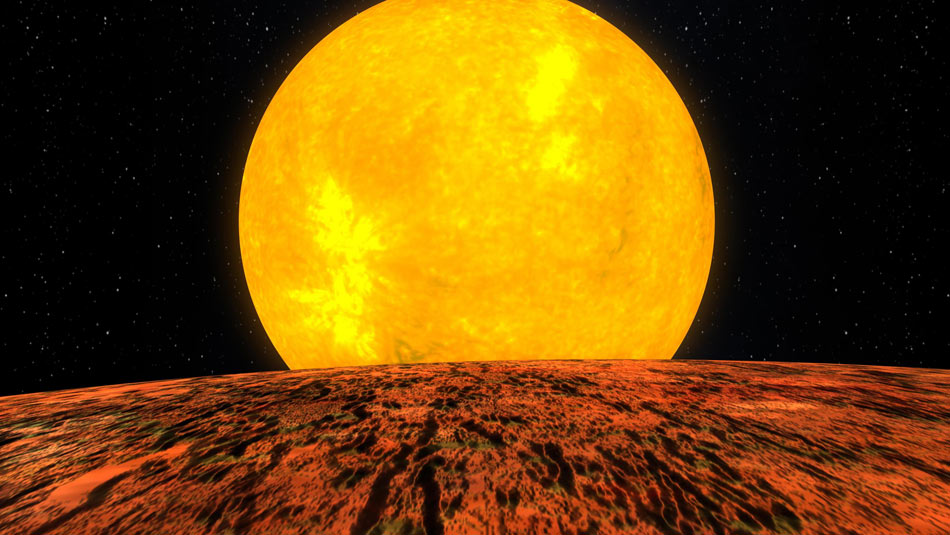
An Imagined Canyon on Planet Kepler 10-B
The daytime temperature is expected to be more than 2,500 degrees Fahrenheit, hotter than lava flows here on Earth, hot enough to melt iron! Many years ago, before Kepler launched, members of what became the Kepler team built a robotic telescope at Lick Observatory to learn to do transit photometry-- detecting drops in brightness of stars when planets pass in front of them. We called it the Vulcan Telescope, named after the hypothetical planet that scientists in the 1800's thought might exist between the Sun and Mercury. A planet that might explain the small deviations in Mercury's orbit that were later explained with Einsteins theory of general relativity.Vulcan is the god of fire in Roman mythology, a name befitting of a world so close to the Sun. The artists rendering of Kepler-10b is reminiscent of that hypothetical planet Vulcan. The Kepler team came full circle in its quest. We know that we've only begun to imagine the possibilities.


Imagined View from Planet Kepler 10-B
Kepler-10b orbits one of the 150,000 stars that the Kepler spacecraft is monitoring, a star that is very similar to our own Sun in temperature, mass and size, but older with an age of over 8 billion years, compared to the 4-and-1/2 billion years of our own Sun. It is one of the brighter stars that Kepler is monitoring and about 560 light years from our solar system, which means when the light from this star began its journey toward Earth, European navigators were crossing the Atlantic Ocean for the first time in search of new horizons. Today, we are still exploring and our crow's nest is a space telescope called Kepler. One day, the oceans we cross will be the galaxy itself, but for now, we imagine the worlds we discover by putting all that we have learned from our observations and analyses into the fingers of artists.Kepler-10b must be a scorched world, orbiting at a distance that is more than 20 times closer to its star than Mercury is to our own Sun, with a daytime temperature expected to be more than 2,500 degrees Fahrenheit.The Kepler team has determined that Kepler-10b is a rocky planet, with a surface you could stand on, a mass 4.6 times that of Earth, anda diameter 1.4 times that of Earth.

Wednesday, June 8, 2011

A Day Out In Munnar..


Munnar, which means confluence of three rivers, was the summer resort of the erstwhile British rulers in the colonial days. In the late 19th century, A.H. Sharp planted the first tea bush and since then tea has been the main agricultural crop in the region. Today, the hills around Munnar are blanketed with best-in-class green tea bushes. With its sprawling tea plantations, pristine valleys and mountains and cool air, it’s no surprise that Munnar has been rated the second-best Asian travel destination for 2010.


If you are a true admirer of nature who has a passion for driving, Munnar is your dream destination and cruising along winding smooth roads across mist-sheeted lush green tea gardens is the finest experience you can ever have.


Around every corner is another stunning view. You do not need a map or a guide; all you need is a good pair of shoes and the curiosity to see what is around the next curve. You need not necessarily be a shutterbug; random clicks can get you incredible photographs.


On the way to Munnar, some 22 kms before reaching there, I stopped by Anayirankal dam, a vast expanse of water surrounded by green carpeted hills covered with tea gardens. The distant view of the reservoir follows you for another 15 kms and it’s an excellent location for photography.


The dude who poses here is Varayadu or Nilgiri Tahr, stocky goats with short, coarse fur and a bristly mane. Nilgiri Tahr is an endangered mountain ungulate listed in schedule I of the Indian Wildlife (Protection) Act 1972. Eravikulam National Park which has the highest density and largest surviving population of this species is situated hardly 14 kms from Munnar town. Know more about this endangered species


Does this picture suggest land’s end? It virtually is. This is Top Station, which is 41 kms uphill from Munnar. Located at the border of Kerala and Tamilnadu, this spot offers an ‘awebreathtakingsome’ panoramic view. Strolling down this pathway with steep abyss on both sides is adventurous, rather risky, but the view you get there is one of a kind.


At every other corner you will find women with baskets full of locally grown fruits and vegetables. Don’t forget to bargain and buy tender carrots, passion fruits and wild tomatoes, all farm fresh and delicious.


Anamudi is the highest peak in the Western Ghats situated at a height of 2,695 metres (8,842 feet) above mean sea level. It is located in the southern part of Eravikulam National Park, fifty kilometers from Munnar. It is also the ideal place for wildlife travelers and nature lovers. It literally means “Elephant forehead”.


13 kms away from Munnar, Mattupetty is famous for its highly specialised dairy farm, the Indo-Swiss project. More than 100 varieties of high yielding cattle are reared here. The Mattupetty Lake and Dam, just a short distance from the farm, is a gorgeous picnic spot. The sprawling Kundala tea plantations, Kundala Lake and the echo point are other attractions in the vicinity. A boat cruise on the lake is the best way to enjoy the leisure.


Bristling with wildlife and crystal clear streams, the enticing charm of Munnar is simply irresistible. The area has many attractions within a short distance of the town of Munnar, including the Sandalwood Forest of Marayoor and the Chinnar Wildlife Sanctuary.


The Eruption that shook Chile and Argentina..


This handout picture released by the Chilean Air Force shows the cloud of ash billowing from Puyehue volcano near Osorno in southern Chile, 870 km south of Santiago, taken on June 5, 2011. Puyehue volcano erupted for the first time in half a century on June 4, 2011, prompting evacuations for 3,500 people as it sent a cloud of ash that reached Argentina. The National Service of Geology and Mining said the explosion that sparked the eruption also produced a column of gas 10 kilometers (six miles) high, hours after warning of strong seismic activity in the area.


A cloud of ash billowing from Puyehue volcano near Osorno in southern Chile, 870 km south of Santiago, on June 5, 2011. Puyehue volcano erupted for the first time in half a century on June 4, 2011, prompting evacuations for 3,500 people as it sent a cloud of ash that reached Argentina. The National Service of Geology and Mining said the explosion that sparked the eruption also produced a column of gas 10 kilometers (six miles) high, hours after warning of strong seismic activity in the area.


Lightning is seen amid a cloud of ash billowing from Puyehue volcano near Osorno in southern Chile, 870 km south of Santiago, on June 5, 2011. Puyehue volcano erupted for the first time in half a century on June 4, 2011, prompting evacuations for 3,500 people as it sent a cloud of ash that reached Argentina. The National Service of Geology and Mining said the explosion that sparked the eruption also produced a column of gas 10 kilometers (six miles) high, hours after warning of strong seismic activity in the area.


A column of smoke and volcanic lightning are seen over the Puyehue volcano, over 500 miles south of Santiago, Chile, Sunday June 5, 2011. Authorities have evacuated about 600 people in the nearby area. The volcano was calm on Sunday, one day after raining down ash and forcing thousands to flee, although the cloud of soot it had belched out still darkened skies as far away as Argentina.


A column of smoke and volcanic lightning are seen over the Puyehue volcano, over 500 miles south of Santiago, Chile, Sunday June 5, 2011. Authorities have evacuated about 600 people in the nearby area. The volcano was calm on Sunday, one day after raining down ash and forcing thousands to flee, although the cloud of soot it had belched out still darkened skies as far away as Argentina.


A blanket of volcanic ash covers a neighborhood in San Carlos de Bariloche, southern Argentina, Sunday, June 5, 2011. The Puyehue volcano, dormant for decades, erupted in south-central Chile on Saturday. The wind carried ash across the Andes to Argentina, dusting this tourist town which had to close its airport.


A car is completely covered in volcanic ash in San Carlos de Bariloche, southern Argentina, Sunday June 5, 2011. The Puyehue volcano, dormant for decades, erupted in south-central Chile on Saturday. The wind carried ash across the Andes to Argentina, dusting this tourist town which had to close its airport.


A man removes volcanic ash from his roof using water from a garden hose in San Carlos de Bariloche, southern Argentina, Sunday June 5, 2011. The Puyehue volcano, dormant for decades, erupted in south-central Chile on Saturday. The wind carried ash across the Andes to Argentina, dusting this tourist town which had to close its airport.

Monday, September 13, 2010

Induce Rains With Planes...

In a new revelation, the US National Center for Atmospheric Research had said that under the right conditions, passenger jets, in particular during take-offs or landings, can ‘punch’ holes into clouds to induce rains or snowflakes, similar to the cloud-seeding effect.

The phenomenon was first noticed when Andy Heymsfield, a scientist at the US center, who was aboard a research plane when it accidentally punched a hole into a cloud, west of the Denver Airport in 2007. Later, based on the satellite images and radar readings, it was concluded that this flight had indeed induced odd-shaped snowflakes into the city. Subsequent experiments conducted also showed similar results. Take a look at some hole-punch clouds (for long it was assumed to be the work of aliens)

Heymsfield goes on to say that the ideal conditions for such as occurrence, include the cloud layer being at a subfreezing temperature (below -15 degree Celsius) and having an up-slope of winter winds. Such conditions are more common in the Pacific Northwest and Western Europe.

Before this disclosure, weather modification experiments have long existed, though the effectiveness of the cloud-seeding process remains a topic of debate.

What is cloud-seeding?
Cloud-seeding is a method of changing the amount of precipitation from clouds by typically dispersing silver dioxide, dry ice (frozen carbon dioxide), salts or other substances.

Has India ever tried to artificially induce rain?
Yes, we have. According to this HT report, Mumbai Corporation did attempt to artificially induce rain last year by sprinkling sodium iodide over the Tansa and Modak Sagar lakes, but it didn’t work then.

Which countries are into cloud-seeding?
Many countries are, in particular those from the Middle-East. The region, which rarely witnesses rainfall, have had their governments invest heavily into various cloud-seeding research programmes. As per The National report, the government programme in the UAE owns two planes carrying sensitive equipment that releases a mixture of salts such as potassium chloride, sodium chloride, and small amounts of magnesium. This ensures that the droplets became so heavy that they fall as rain.

Does this activity have an impact on the environment?
Well, in this story by ABC News, the New South Wales government in fact plans to increase cloud-seeding as results from such programmes over the last 6 years indicate snowfalls have increased by 14 per cent without adverse environmental impacts.

Is it also possible to prevent rain using the same method?
The Chinese, who are experts in the art of ‘weather modification’, had allegedly used a technique they had mastered to not induce but to dispel clouds during the Beijing Olympics in 2008. According to this report by the LA Times, the Chinese meteorologists had been practicing their ‘rain mitigation’ techniques since 2006.

Whether one may like it or not, the world’s artificially inducing rains – a phenomenon which many scientists believe could solve water problems and even negate the influence of the monsoons. The government here, might want to look at this more keenly.

Also, the next time someone mentions that you brought the rain along, you know what could have happened.

Wednesday, April 21, 2010

Iceland Volcano: Lightning Adds Flash to Ash... ..

White-Hot Show at Iceland Volcano
A blast of white-hot lightning crackles over Iceland's Eyjafjallajökull volcano on Sunday. Clouds of volcanic ash from Eyjafjallajokull have snarled European air traffic for nearly a week.
National Geographic Your Shot submitter Peter Vancoillie took the photograph from about 18 miles (30 kilometers) away from the volcanic lightning storm, which not "unlike a regular old thunderstorm," said Martin Uman, a lightning expert at the University of Florida in Gainesville.

The same ingredients are present: water droplets, ice, and possibly hail—all interacting with each other and with particles, in this case ash from the eruptions, to cause electrical charging, Uman said.

The volcanic-lightning pictures are 'really very sensational,' Uman said. 'Somebody ought to be up there with an HD movie camera—it's ready for the IMAX theater.'

Purple Bolts at Iceland Volcano
Italian photographer and scientist Marco Fulle flew at sunset on Sunday over Iceland's erupting Eyjafjallajokull volcano to capture this picture of purple lightning bolts streaking through the sky.
Much of the lightning generated by the Iceland volcano is better termed long sparks, said the University of Florida's Uman. Those may include a new type of lightning recently found over an Alaska volcano.
It's unknown how such sparks form, though one possibility is that electrically charged silica-an ingredient of magma-interacts with the atmosphere when it bursts out of Earth's crust, Steve McNutt of the Alaska Volcano Observatory said in February.

Fire, Ice, and Lightning
Fiery lava mixes with blue ash and golden lightning over the erupting Eyjafjallajokull volcano in an April 18, 2010, picture.
The Iceland volcano's lightning is probably creating distinct symphony of sounds, said the University of Florida's Uman. For instance, small sparks of about 30 feet (9 meters) to about 300 yards (91 meters) make sounds like rifle shots, while the miles-long bolts produce the deep, familiar rumbling we associate with thunderstorms, he explained.

Stormy Mix at Iceland Volcano
Pictured Sunday, lightning at the Eyjafjallajokull volcano branches off in many directions-an interesting phenomenon, according to the University of Florida's Uman.
Every bolt has a direction that it travels, Uman explained: A spark begins in electrically charged spot and then travels either up, down, or sideways until it reaches an oppositely charged area.

Lava and Lightning in Iceland
Spurts of lava mix with lightning over Iceland's Eyjafjallajokull volcano on Sunday.
National Geographic Your Shot submitter Oli Haukur Myrdal captured the electrifying light show. All types of lightning, particularly volcanic lightning, are still largely mysteries to scientists, University of Florida's Uman said.
Since people can't easily get inside thunder and lightning storms, no one knows exactly how they form, he said. However, scientists can install instruments near volcanoes' vents to measure certain data, such as the lightning-detection devices that scientists are installing right now in Iceland, he said.

Flash and Ash at Volcano
Lightning pierces the erupting volcano's ash cloud in a National Geographic Your Shot photograph taken by Olivier Vandeginste on Sunday.
Inhaling the tiny pieces of glassy sand and dust in the cloud can cause irritation of the eyes, nose, and throat, say experts who advise Europeans to stay indoors when the ash begins to fall. Finer particles can also penetrate deep into the lungs and cause breathing problems, particularly among those with respiratory issues like asthma or emphysema.
But if people could witness the volcanic lightning safely, it would be an incredible experience, Uman said.
'Everyone would want to see that,' Uman said. 'It's like going to see aurora borealis near the North Pole-it's a once-in-a-lifetime experience.'

Iceland Volcano Erupts, Under Ice This Time

Iceland Volcano Spews Giant Ash Clouds

Volcanic Ash Halts Much of N.Europe Air Travel..

A huge ash cloud from an Icelandic volcano caused further air travel chaos across Europe on Friday on a scale not seen since the Sept. 11 attacks, leaving hundreds of thousands of passengers stranded.

About 17,000 flights were expected to be cancelled on Friday due to the dangers posed by clouds of volcanic ash from Iceland, aviation officials said, with airports in Britain, France, Germany, and across Europe closed until at least Saturday.

"I would think Europe was probably experiencing its greatest disruption to air travel since 9/11," said a spokesman for the Civil Aviation Authority, Britain's aviation regulator.

"In terms of closure of airspace, this is worse than after 9/11. The disruption is probably larger than anything we've probably seen."

Following the Sept. 11, 2001 attacks on Washington and New York, U.S. airspace was closed for three days and European airlines were forced to halt all transatlantic services.

Vulcanologists say the ash could cause problems to air traffic for up to 6 months if the eruption continues, but even if it is short-lived the financial impact on airlines could be significant.

The fallout hit airlines' shares on Friday with Lufthansa, British Airways, Air Berlin, Air France-KLM, Iberia and Ryanair down between 0.8 and 2.2 percent.

The International Air Transport Association said only days ago that airlines were just coming out of recession.

The volcano began erupting on Wednesday for the second time in a month from below the Eyjafjallajokull glacier, hurling a plume of ash 6 to 11 km (4 to 7 miles) into the atmosphere.

Volcanic ash contains tiny particles of glass and pulverised rock that can damage engines and airframes.

In 1982 a British Airways jumbo jet lost power in all its engines when it flew into an ash cloud over Indonesia, gliding towards the ground before it was able to restart its engines.

The incident prompted the aviation industry to rethink the way it prepared for ash clouds, resulting in international contingency plans which were activated on Thursday.

Of the 28,000 flights that usually travel through European airspace on an average day, European aviation control agency Eurocontrol said it expected only 11,000 to operate on Friday while only about a third of transatlantic flights were arriving.

Eurocontrol warned problems would continue for at least another 24 hours.


AIRSPACE CLOSED

Britain's air traffic control body said all English airspace would be closed until 2400 GMT on Friday although certain flights from Northern Ireland and Scottish airports were being allowed to take off until 1800 GMT.

"When the experts give us the all clear we'll get the operation back up and running," Paul Haskins, head of safety at National Air Traffic Service, told BBC radio.

"We're working with both the Civil Aviation Authority and the Met Office (weather officials) to understand what parameters would need to be in place before it is safe to allow aircraft to operate again."

There were no flights from London's Heathrow, Europe's busiest airport, which handles some 180,000 passengers a day, while officials at Germany's Frankfurt airport, Europe's second busiest, said flights would be suspended from 0600 GMT.

Around 2,000 people slept overnight at Amsterdam's Schiphol Airport, a spokewoman said, adding they did not expect airspace in the Netherlands to reopen soon.

Eurocontrol said airspace was closed over Belgium, Denmark, Sweden, Norway, Finland, Estonia, the north of France including all Paris airports, and at airports in northern Germany and parts of Poland. Northern Czech airspace was also closed.

Polish officials said if the disruption continued, it might force a delay in Sunday's funeral for President Lech Kaczynski and his wife who were killed in a plane crash last Saturday.

Airlines across Asia and the Middle East have also cancelled or delayed flights to most European destinations.

The air problems have proved a boon for rail companies. All 58 Eurostar trains between Britain and Europe were operating full, carrying some 46,500 passengers, and a spokeswoman said they would consider adding services if problems persisted.

The Association of British Insurers said volcanic eruptions were not always covered by travel insurance for cancellation and delay, but some airlines issued statements confirming they would refund fares or change flights.

The UK's Health Protection Agency said it expected a small amount of the volcanic plume with low levels of sulphur dioxide would reach ground level in Britain later on Friday.

"This is not expected to be a significant threat to public health," it said in a statement.

(Reporting by London, Dublin, Paris, Oslo, Stockholm, Helsinki, Amsterdam, Brussels, Geneva and Copenhagen newsrooms; Editing by Elizabeth Fullerton)

Wednesday, March 24, 2010

Air India May Lose 'National Career' Tag... ...

The Union Cabinet is set to meet soon to decide if beleaguered state-owned carrier Air India should retain its 'national' character at all. It will also debate if strategic disinvestment is the best way forward for the airline, which is estimated to have accumulated Rs 7,200 crore in losses in 2009-10.

With most of Air India's woes emanating from its international operations - where it loses around Rs 3,000 crore a year on 30 routes - a group of ministers (GoM), chaired by finance minister Pranab Mukherjee, has recommended that the airline stop flying to these routes.

"This will change the character of Air India," a government functionary said, adding this would turn Air India into a regional airline.

The civil aviation ministry is preparing a detailed note for the Cabinet on the carrier's financial health and turnaround measures recommended by the GoM. "Cutting down loss-making international routes will have serious implications. Basically, the government has to decide if Air India continues to fly abroad or within India alone," the source said.

At the same time, the Cabinet may also debate the issue of strategic disinvestment as a long-term viable option for the carrier.

"The government cannot pump money into the National Aviation Company of India Ltd (Nacil) forever," the government source said. But, it is likely that the Cabinet refers back some of these issues to the GoM for its detailed and considered opinion, the source added.

A major blow to Nacil's finances comes from prestigious but loss-making daily non-stop flights to New York from Delhi and Mumbai on the latest long-range fleet of Boeing, accounting for losses to the tune of Rs 750 crore a year.

The GoM, set up to monitor Air India's turnaround plan, was also to decide on the politically sensitive matter of wage cuts of Air India's 31,000 employees. But it has now left the decision for the Cabinet.

To avail government bailout, the carrier was asked to undertake cost-cutting measures that would help it save around Rs 2,000 crore by March 2010. Air India was able to cut costs to the tune of Rs 700-800 crore till December last year.

As part of its turnaround strategy, the carrier has shortlisted five candidates for the post of chief commercial. A newly formed interview panel will interview these candidates on March 27

The carrier recently received a shot in the arm with the government releasing Rs 400 crore as a first tranche towards equity infusion. Air India had asked for Rs 5,000 crore as equity infusion and a letter of comfort from the government to convert its high-cost debt into low-cost ones.

Galaxy with Key to Milky Way Creation Found... ...

A team of scientists from the UK and the US has discovered a galaxy far away from us which is churning out stars 250 times faster than our Milky Way. The discovery of the galaxy, about 10 billion light years away from the earth, will help researchers understand how the Milky Way was formed.

Galaxy SMM J2135- 0102 has four distinct star- forming regions, each of which is 100 times brighter than Milky Way locations such as the Orion Nebula. The team which discovered the galaxy was led by scientists from the UK's Durham University.

It also included researchers from European Southern University and the Massachusetts based Harvard- Smithsonian Center for Astrophysics." The new galaxy is forming stars at about 250 suns per year. Our Milky Way is forming about two suns per year," lead scientist Mark Swinbank of Durham University said. Because of the time it takes light to reach the earth, the scientists observed the galaxy as it would have appeared 10 billion years ago - just three billion years after the Big Bang.

It was Milky Way- sized at the time. But today, 10 billion years later, it would have grown into a giant elliptical galaxy much more massive than the Milky Way." When we look at the stars in the Milky Way, we find that most are about 10 billion years old. So, to understand how the Milky Way was formed, we must look back to these times. In this study, we have done just that," Swinbank said. "The main result of our study is that we have located four individual star- forming regions.

Each of these regions is forming stars much more rapidly than we would expect, given their sizes. In essence, the regions are much more efficient at forming stars than we typically see in the local universe," he said. The findings indicate star formation was more vigorous in the early universe. The paper was published on Sunday in the science journal Nature.

Thursday, March 18, 2010

A Peek at Next-Generation Agni-V... ...

Shrouded in secrecy for its political implications, the first visual impressions of India's most ambitious nuclear delivery system, the Agni-5 ballistic missile, are out. Officials with the Agni programme in Hyderabad confirmed the pictures were an accurate depiction of the in- development weapon.

On February 10, Agni programme director Dr Avinash Chander had told Headlines Today, "The Agni-5 looks similar to the Agni-3, except that it is longer as a result of an additional propulsion stage."

Still at least a year away from its first test-firing-an official estimate says February 2011- the Agni-5 has already acquired a formidable global reputation. In October last year, in its first ever reference to an Indian weapon programme, China's state-owned People's Daily newspaper pointed out that "India's Agni-5 missile is highly road-mobile, and effectively puts Harbin, China's northernmost city within striking range."

The Agni-5 is being built to deliver a nuclear warhead out to ranges of 5,000-6,000/ km. Sources reveal that 60 per cent of the first Agni-5 missile system is complete, with work now focused on the weapon's crucial third stage. Scientists are currently tweaking the missile's payload structure, introducing extra heating and making alterations to the re- entry mechanism.

The missile will also be India's first to be propelled by a composite rocket motor as opposed to a metallic one. With the 3,500-km-range Agni-3 to enter service with India's Strategic Forces Command- which governs all nuclear weapons- this year, the Agni-5 will be put through a similar four-flight trial between 2011-2013.

Tuesday, March 9, 2010

Dinosaur Country....... ..

India has turned out to be agold mine of clues - from an abundance of eggs to tell - tale dung - to the lives of dinos.
The discovery of an ancient dinosaur-eating snake species from a Gujarat village that made international headlines this past week was not a chance discovery. It was one more piece, a significant one at that, in the slowly unfolding jigsaw puzzle of India's fascinating fossil heritage.
Most Indians may not know that the geological history of Indian dinosaurs spans the Triassic, Jurassic and Cretaceous ages - spanning from about 230 million to 65 million years ago. In fact, some of the first fossils that were recognised as those of dinosaurs were found in India way back in 1828. The fossils - discovered by a British army officer William Sleeman, who was better known for wiping out the 'thuggee' menace, in Jabalpur - were described by the Scottish missionary Stephen Hislop in scientific literature in 1859. The species was later named Titanosaurus indicus.
Since that discovery, scientists with the Geological Survey of India ( GSI) have found remains of dinosaurs belonging to different ages of the "era of reptiles" which is believed to have come to an end some 65 million years ago. In popular psyche, dinosaurs are invariably connected with the Jurassic period - the middle age of the geological times - scale - made famous in sci- fi movies.
But the Triassic period extended from 250 to 200 million years ago, followed by Jurassic, which spanned from 145 to 200 million years. It was followed by the Cretaceous period extending from 145 to 65 million years ago. This is supposed to have been the golden age of dinosaurs, which came to an end with a massive asteroid hitting the planet. Indian dinosaurs are believed to have been wiped out by the Deccan volcanic eruption.
Though fossils found in India belong to all three ages, most of them are from the late Cretaceous period. Over the years, GSI scientists have found bones, skeletons, well- preserved eggs, egg shell debris, dung and other fossil fragments in western and central India, and even in the south. Fossilised footprints, or trackways, of the gargantuan creatures have not been found in any dinosaur- bearing sediments in India.
The earliest discovery of dinosaurs eggs were made from the Lameta sediments in the Kheda district of Gujarat in 1981.
Scientists were exploring the region for fossils in the area near Balasinor village, which had limestone quarries operated by the cement company, ACC. "A big boulder fell apart when the mine was blasted. I noticed that it contained seveneight spherical pieces. It was almost as if some eggs had been kept in a basket," recalls Dhananjay M. Mohabey, senior paleontologist with the GSI. "We did not know how dinosaur eggs looked like. This was the first time we were seeing something like this."
This discovery led to a resurgence of dinosaurs research in India, leading to a spate of finds belonging to the Late Cretaceous period in Gujarat, Madhya Pradesh, Maharashtra and Andhra Pradesh in the past three decades. A sole occurrence of a single egg has been recorded from the Ariyalur area in Tamil Nadu - the only record of an Indian dinosaur egg from marine sediments.
As many as 10,000 dinosaur eggs have been found at different nesting sites in Gujarat, Madhya Pradesh and Maharashtra.
Scientists believe that there could be up to 30,000 eggs at different locations. Most of these eggs belong to the titanosaurus. Eggs, nests and nesting sites provide an insight into the social and nesting behaviour of this class of dinosaurs.
These animals used to bury their eggs in soft sands near riverbanks and in a few rare nests, eggs have been found arranged in circular or linear patterns.
From dung found around Pisdura village near Nagpur, scientists have inferred what the herbivore dinosaurs used to eat. An analysis of this dung, in fact, revealed the remains of a grass family which turned out to be the oldest record of grasses found anywhere in the world.
"Evidence suggests that the environment during the Late Cretaceous period in India provided an ideal habitat for breeding and nesting of dinosaurs. But these reptiles were struggling to survive the initial onslaught caused by the Deccan volcanic eruption near the end of the Cretaceous period," explains Mohabey, who first found a complex set of fossils at Dholi Dungri village in Gujarat in 1987. It has now turned out to be that of an ancient snake along with fossils of crushed eggs and dino hatchlings. The Indian dinosaur eggs and plant- bearing dung are unique in the world for their diversity and abundance and offer promising material for future research on dinosaurs.
Most eggs found in India belong to the plant-eating sauropod dinosaurs, but the country was also home to carnivore dinosaurs as well. The most remarkable discovery of a carnivore is that of Rajasaurus narmadensis - a new species found at Rahioli village in the Narmada basin of Gujarat. The discovery represents the first skull ever assembled of a dinosaur of any kind in India.
Rajasaurus narmadensis - which means "regal dinosaur from the Narmada" - was a significant predator that was related to species on continental Africa, Madagascar and South America.
The discovery of this 65-millionyear-old was a joint effort of Suresh Srivastava of GSI, Ashok Sahni of Panjab University, Chandigarh, and Jeff Wilson of the University of Michigan, Ann Arbor ( USA). The stocky, 30-foot dinosaur had an unusual head crest and would have pursued a diet that included the long-necked sauropoddinosaurs that roamed the Narmadaregion. F INDING A dinosaur fossil, reconstructing the evidence and then presenting the find to scientific community is a long, torturous process that could sometimes take decades. Geologists look for dinosaur fossils in different rock sediments which have already been mapped. Systematic excavation of such areas is undertaken and when fossils are found the location is carefully mapped before the fossils are labeled and removed from there.
The rocks are scanned to see presence of bones. Then the rock sediments are removed through mechanical and chemical processes.
This prepares the fossils for reconstruction, body part by body part such as skull, jaw, limbs, pelvis, and so on. Fossils of associated including plants, flowers and animals are also studied in detail.
Only after this long process can anyone claim to have found a dinosaur fossil. Many a times false announcements are made. GSI scientists, for instance, clarify that the egg fossils reported last year from Tamil Nadu didn't belong to dinosaurs. The science of paleontology isn't as exciting as they make it out to be in the sci- fi movies.

M.F. Hussain's Paintings... Judge Yourself...... ..

If a person dresses like a Sikh Guru, thousands of Sikhs gather and destroy their establishments , threaten to kill him, announce a bounty on his head - Sikhs are not criticised for being communal and intolerant.

If a Danish journalist depicts the Prophet of the Muslims , Muslims all over the world rise in anger, there is violence, a booty on the head of the Journalist - Muslims are not criticised for being communal and intolerant.

If MF Hussain draws paintings depciting Hindu Gods and Goddesses positions (which relations are not borne out by ancient texts at all ) and Hindus merely protest , they are called communal, intolerant and taught lessons in secularism by one and all.

The problem apparently is not with Sikhs and Muslims, it is with us, the Hindus, because we are not violent, we accept whatever is dished out to us , we do not have the guts to say that this is wrong , we seek acceptance from outsiders rather than from our conscience. We worship the same Gods and Godesses but don't stand up for them when the time comes.

Be a judge of Hussain' s paintings below.


Goddess Durga ######### union with Tiger


Prophet ' s Daughter Fatima fully clothed


Goddess Lakshmi naked on Shree Ganesh ' s head


M.F. Hussain ' s Mother fully clothed
Naked Saraswati


Mother Teresa fully clothed


Naked Shri Parvati


Hussain ' s Daughter well clothed


Naked Draupadi


Well clothed Muslim Lady


Naked Lord Hanuman and Goddess Sita sitting on thigh of Ravana


Muslim poets Faiz, Galib are shown well-! clothed


Full Clad Muslim King and naked Hindu Brahmin. The above painting clearly indicates Hussain ' s tendency to paint any Hindu as naked and thus his hatred


Naked Bharatmata - Hussain has shown naked woman with names of states written on different parts of her body. He has used Ashok Chakra, Tri-colour in the painting. By doing this he has violated law & hurt National Pride of Indians. Both these things should be of grave concern to every Indian irrespective of his religion


Out of the four leaders M. Gandhi is decapitated and Hitler is naked. Hussain hates Hitler and has said in an interview 8 years ago that he has depicted Hitler naked to humiliate him and as he deserves it ! How come Hitler ' s nudity cause humiliation when in Hussain ' s own statement nudity in art depicts purity and is in fact an honour ! This shows Hussain ' s perversion and hypocrisy